Unmasking: A Conversation
A Conversation About Unmasking
I’ve spent 37 years painting every day, and somewhere along the way it became clear that I was really doing one thing: unmasking.
We all wear masks. Not just the ones we show the world, but the quieter ones we wear even with ourselves — the protective layers we build to soften pain, hide vulnerability, or to simply keep going when life gets heavy. Over time those masks become almost invisible.
They start to feel like who we are.
In Japan there is an old understanding that each of us has three faces: the one we show the world, the one we show to those close to us, and the hidden third — the truest self we rarely reveal, even to ourselves. Over these foundational masks we layer many more: the mask of our profession, the mask we wear to be loved or accepted, the mask we put on to keep friendships, the mask of strength we show our children, and the mask of survival we wear when life demands endurance. We’re often told to “put on a brave face,” as if hiding our struggle is a virtue.
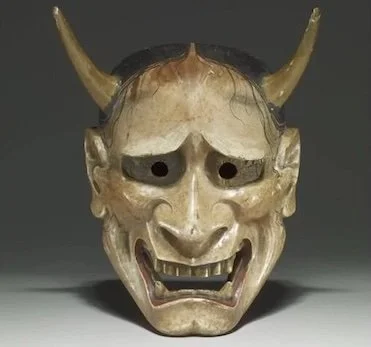
Japanese ONI Mask
Some masks can serve us. In Japanese tradition, fierce Oni masks were sometimes used not just to ward off demons, but to embody them when necessary — giving courage or helping us survive what felt unbearable. The goal isn’t necessarily to remove every mask, but to return to those original three — and to make sure no mask ever becomes who we are.
Eventually the layers can become so thick we can no longer tell where the performance ends and the real self begins. All that remains is the bone.
My paintings are where I try to peel these layers back. The recurring skull isn’t about death — it’s about truth. It is the bare, honest core that exists beneath every mask we wear. In a world full of performance and constructed identities, the skull stands as the simplest and most unflinching symbol of what remains when we finally stop pretending. It doesn’t judge. It doesn’t perform. It simply is.
All that remains is the bone.
I often portray figures in the nude because it shows them as they truly are — stripped of clothing, status, and outward armor. In the same way, we should have the opportunity to accept our own skull — our unmasked self — without judgment. To look at it clearly, with kindness, and recognize that this is enough.
Painting has never been my financial goal. It is simply how I experience hope. My deepest wish is that this conversation — this shared process of unmasking — becomes the real success of my practice. That the work I have no choice but to do might grow in others, as they begin to share their own experiences and stories.
If you feel called to join this conversation, I invite you to look at the work with me. To sit with it honestly. To consider your own masks, your own skull beneath them. I will gladly share these stories of courage if people are willing — and I hope others will feel safe enough to share theirs too. Together, perhaps we can clear the vision forward — not by pretending to be perfect, but by having the courage to be real. The more of us who are willing to unmask, the clearer the path becomes for everyone.
The Skull as Truth
The skull is not a symbol of death in my work. It is a symbol of radical truth — what remains when every mask is finally stripped away. This idea draws from several deep wells. In Jungian psychology, the skull relates to the Shadow — the hidden, often uncomfortable parts of the psyche we try to deny. It also echoes the alchemical stage of Nigredo (the blackening), where the ego must break down before any real transformation can occur. Jung saw facing mortality and the unconscious as essential to becoming whole.
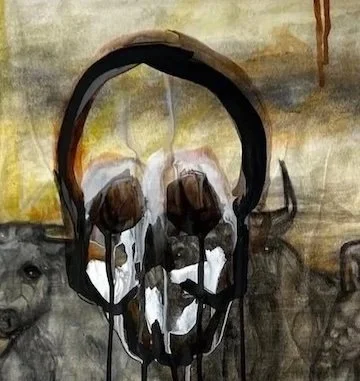
Skull detail from “ Rape of Europa ”
Modern existential psychology reinforces this. Thinkers like Irvin Yalom and Ernest Becker have shown how much of human behavior is a defense mechanism — a mask — against the terror of death. When we finally sit with the skull, when we stop running from our own finitude, we gain the chance to live more honestly.
In my paintings the skull appears again and again — sometimes looming, sometimes revealed beneath layers, sometimes staring directly at the viewer. It is my memento veri — a reminder of truth.
The quiet hope I keep returning to is this: even the skull is not empty. Beneath the bone, beneath the final mask, there is still something luminous. Something that endures. Something that refuses to be reduced to nothing.
The skull is not the end of the story. It is the beginning of seeing clearly.
We may not like what we Find.
Reaching the skull — the moment when every mask has fallen away — is not always a triumphant or beautiful experience.
Sometimes what we find there is not a noble or enlightened face. It can be ugly, selfish, weak, angry, or deeply flawed. We may not like the person we see when we finally stand completely unmasked. The raw truth can be uncomfortable, even painful. We discover parts of ourselves we have spent years avoiding — the harm we have caused, the fears we have denied, the pettiness we have hidden, the desires we are ashamed of.
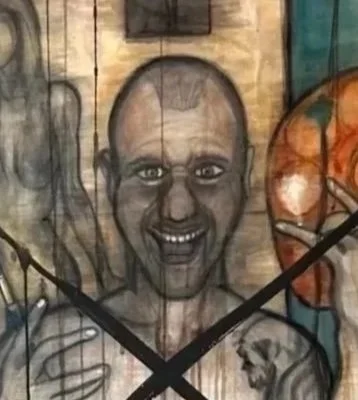
Detail from Artist self portrait, still with the grin of the ONI
This is one of the hardest parts of unmasking: the courage to look at what we do not want to see.
And yet, knowing this true self — even when we do not like it — is profoundly valuable.
Because only when we stop pretending can we begin to change with honesty. Only when we accept the full truth of who we are can we move forward without the weight of constant performance. The skull does not demand that we love every part of ourselves. It simply asks us to see it clearly, without illusion.
There is a strange freedom in this. There is relief in no longer needing to maintain the mask. There is quiet strength in saying, “This is who I am — flaws and all.”
The skull is not a judgment. It is an invitation to begin again, this time from truth.
For me, I wear the grin of the ONI (demon) as my true self, which is what I embody to ward off the demons.
And in that honest beginning, even if we do not like everything we see, something real can finally grow. I know that I am Dark yet hopeful.
Studio visits, or related works: blairaiken@raincage.com
Dark yet hopeful.
Blair
From the masked man (still working on it), blairaiken@raincage.com