Click image to view full screen
Fall of Man Triptych [ 72” x 44” panels ] ·Carbon pencil, blackening watercolours, and inks on paper mounted to canvas ·[ 2017–2023 ]
The mask of temptation and denial, when humanity began to hide their true self.
This painting reimagines the Garden of Eden as a fractured, modern space of temptation, choice, and distraction in the human condition.
In the central panel, Adam kneels, gaze locked on one of many apples on the Tree of Life — symbols of life’s temptations, which he worships. Opposite him, Eve dances with her own distractions, neither seeing the other nor the looming snake that divides them. The snake bears a skull: its mask removed, embodying raw honesty and truth — we choose not to recognize it, or each other, as life’s static overwhelms us. Inscribed across Eve’s leg: “I have Choice. What does it mean to have Choice?”
Below, a discarded figure from past temptation stares outward, oblivious to the snake above, her eyes fixed on the apple she has already bitten — seeing no evil, yet trapped in its memory. Poppies spread across the forest floor, their addictive force encircling the figures in endless temptation.
The black-and-white side panels frame the scene like sculptures, depicting further sexual temptation poisoned by reaching apples and poppies. The left figure covers her ear (hears no evil); the right holds her tongue (speaks no evil). Crosses on each panel mark life’s inevitable crossroads — reminders of the selfish guilt we all carry when we allow distraction to waste our potential, ignoring dangers and failing to truly acknowledge one another.
This work took four years to complete — a layered meditation on choice, denial, and the human capacity for both fall and redemption — dark yet eternally optimistic.
Dark yet hopeful,
Studio view, or related works: blairaiken@raincage.com
Inspiration & Personal Connection
This painting draws inspiration from Michelangelo’s monumental fresco *The Fall and Expulsion from the Garden of Eden* on the Sistine Chapel ceiling. I first encountered the work while living in Italy, and it has stayed with me.
Michelangelo’s masterpiece captures the dramatic moment of temptation and expulsion — the serpent offering the fruit, Adam and Eve reaching out, and the anguished departure from paradise. In the psychological interpretation of the Garden of Eden story, the "mask" refers to the fig leaves that Adam and Eve use to cover their nakedness after eating the forbidden fruit. This act symbolizes the birth of shame, self-consciousness, and the creation of a false persona (or ego) to hide their true selves, both from each other and from the divine. In my version, I reimagine this biblical scene through my own lens of rupture, consequence, and the search for hope amid the fall, while adding the eastern art influence see, hear, speak no evil from the sculptures at the Tosho-gu shrine in Nikko Japan.
After a painful divorce, my experience from the pain that followed that temptation where others filled my families world with what they thought, saw, heard, and spoke. While others chose denial, over unmasking.
The blackening layers trace the weight of that original choice, the slow accumulation of consequences, and the enduring human struggle between innocence and knowledge. Yet even in the moment of expulsion, a faint light persists — a quiet reminder that every fall carries within it the possibility of return, redemption, or deeper understanding.
Dark yet hopeful.
Studio view, or related works: blairaiken@raincage.com
Dark yet hopeful.
← Previous Back to Portfolio Works Next →
← Previous Back to Selected Works Next →
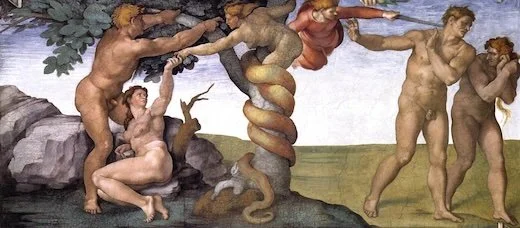
Michelangelo, The Fall and Expulsion from the Garden of Eden (Sistine Chapel ceiling), 1508–1512
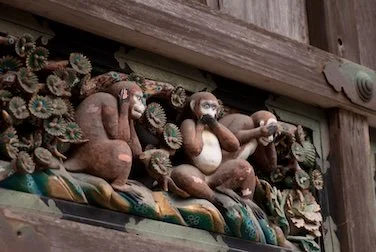
Tosho-gu shrine in Nikko Japan. Hear, Speak , see no evil.