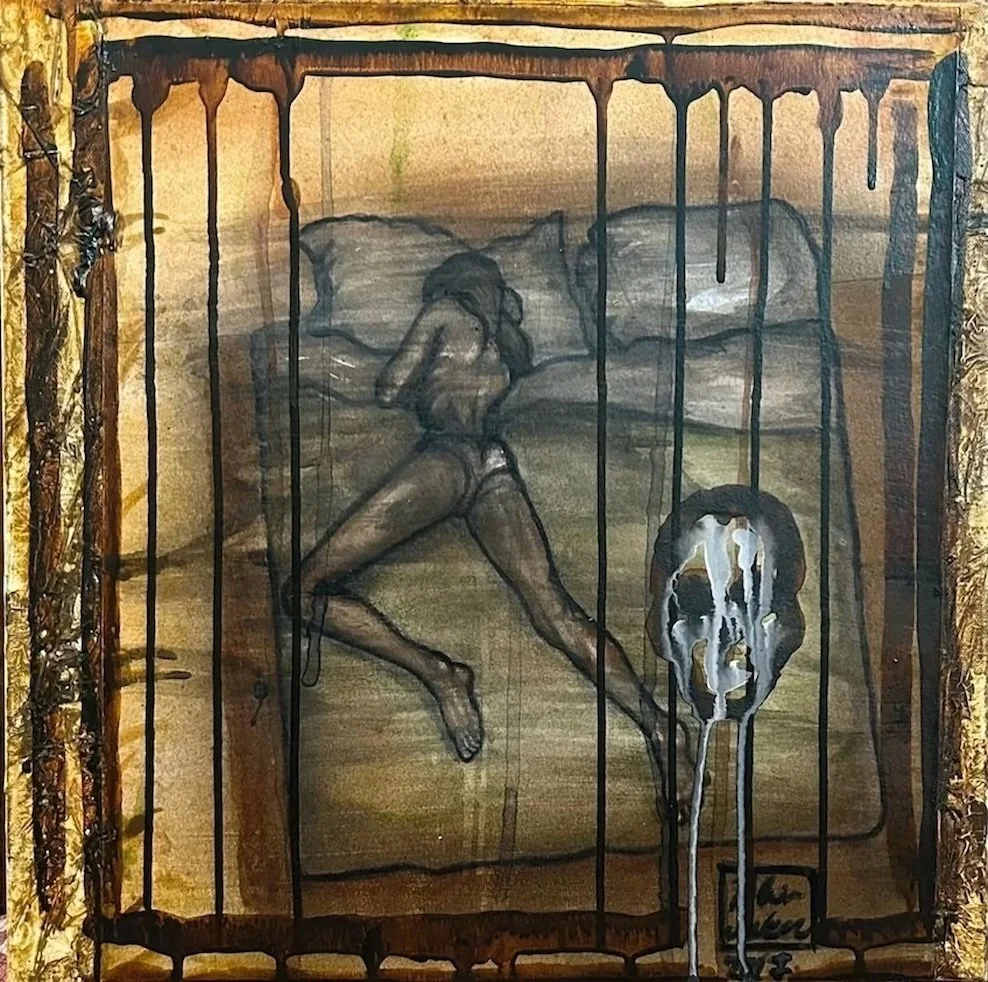
Persephone Trapped by Hades [ 14” x 14” ]· Carbon pencil, blackening watercolours, and inks on paper mounted to canvas · [ 2020–2025 ]
The mask we present to the world to meet societal expectations while concealing the truth.
This painting reimagines Persephone trapped by Hades as a solitary, intimate captivity on a bed of pillows. She lies facedown her body angled slightly upward, arms resting at her head and body— not bound, but held in a stillness that speaks of acceptance laced with inner resistance. The bed is low and wide, pillows scattered in disarray, their fabric stained with blackening drips that rise from the sheets and pool beneath her.
The blackening layers creep from the bedding and pillows, saturating the linen and climbing the walls of the chamber, turning the intimate space into a soft but inescapable underworld. Persephone’s gaze is downward, fixed on the empty space before her, expression complex: sorrow, resignation, a flicker of quiet defiance beneath the surface. The pillows cradle her like a throne and a prison — comfort made confinement, softness made cage. No fruit appears; the trap is already internal, the bond sealed by her presence in this shadowed bed.
The work confronts the complexity of entrapment in solitude: how abduction can become an internal reality, how desire can bind without chains or visible captor, how the act of being in the wrong place at the wrong time makes the cage personal and inescapable. The blackening drips echo the gradual surrender — the bed as both refuge and underworld, the stillness as both rest and restraint. Hades is absent from the image, yet his presence is everywhere: in the weight of the silence, in the shadows that have claimed the room, in the pillows that hold her captive.
This painting carries a deeply personal weight. The model and I had a complicated relationship that ended in breakup. She later died mysteriously in the Czech Republic. In the quiet aftermath, I found myself carrying guilt — wondering if I had held on instead of releasing her from what I thought was the underworld of our relationship, we might have moved together into spring. We went back and forth like Hades and Persephone. I carry this choice.
Yet even in this moment of entrapment and division, a faint gleam persists — a quiet reminder that no captivity is absolute, and that something essential of the self can still endure, waiting for the possibility of return or transformation.
Dark yet hopeful.
Studio view, or related works: blairaiken@raincage.com
Inspiration & Personal Connection
This painting draws inspiration from Peter Paul Rubens’ dramatic *The Rape of Persephone* (c. 1636–1638). Rubens’ composition captures the violent, swirling moment of abduction — Hades seizing Persephone as she is torn from the world above. The "psychological mask" in the story of Persephone and Hades refers to the Jungian concept of the Persona—the social face or "mask" an individual presents to the world to meet societal expectations while concealing the truth.
In my version, I focus on the mutual trap that binds both figures. Persephone is trapped in the underworld, but Hades is equally trapped by his own desire and the responsibility he now bears. The world above and below now depends on them for the seasons — their union and separation dictating the cycle of life and death, growth and barrenness.
The blackening layers trace the slow, suffocating accumulation of consequence: the loss of freedom, the weight of being claimed, and the quiet grief of lives forever divided. Through this work I explore the complex reality of being held against one’s will — not just physically, but existentially — and the question of which self we truly are when together and when apart.
Yet even in this moment of entrapment and division, a faint gleam persists — a quiet reminder that no captivity is absolute, and that something essential of the self can still endure, waiting for the possibility of return, transformation, and her memory.
Dark yet hopeful.
Studio view, or related works: blairaiken@raincage.com
Dark yet hopeful.
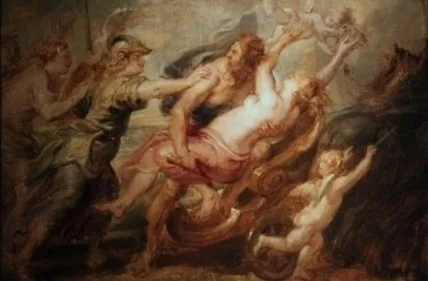
Peter Paul Rubens, The Rape of Persephone, c. 1636–1638