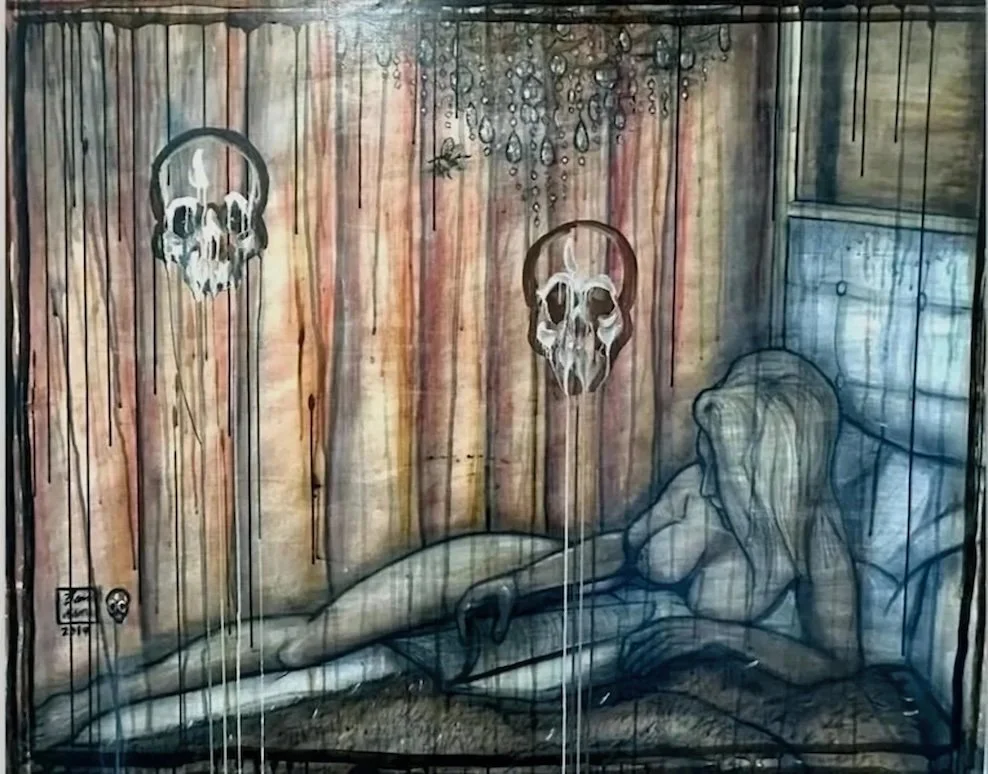
Venus of Urbino ( Kara Aiken ) [ 60” x 55” ·] Carbon pencil, blackening watercolours, and inks on paper mounted to canvas · [ 2019–2025 ]
The mask of beauty, harmony, and the modern mirror of desire.
This painting reimagines the reclining Venus as a deeply intimate portrait of my wife Kara, naked in bed. She lies on her side, body relaxed against rumpled sheets, one arm bent at her side, the other resting along her hip flipping pages of a book. Her skin glows softly in the low light of the chandelier above her, curves graceful and familiar, hair spilling across the pillow. Her gaze is soft and direct—looking down with calm confidence, warmth, and quiet strength, lips slightly parted in gentle repose. The pose echoes classical Venus—nude, luminous, timeless—yet it is entirely personal: the body that has carried children, loved, endured, and been loved in return, resting in her private sanctuary. A bee invades the space over her symbolizing fertility, teamwork, and prosperity.
Blackening drips trail from the edges of the sheets and pool beneath her, spreading slowly across the canvas like spilled ink or the quiet shadow of time. The blackening layers are subtle here, almost caressing rather than overwhelming—symbolizing the accumulated depth of love, partnership, and shared life. They do not diminish her; they frame her, deepening the quiet radiance she brings even in vulnerability.
The work is a husband’s meditation on his wife as Venus: goddess of love made human, beauty made intimate, desire made enduring. The reclining nude in bed is both classical and profoundly present—the body known in every curve, every breath, every shared night. The blackening drips echo the passage of years—the tenderness that deepens, the closeness that accumulates, the quiet becoming that happens in marriage.
Yet in the deepest blackening, a faint gleam catches on the curve of her hip and in the corner of her eye—the quiet promise that love remains luminous, unbroken, capable of carrying its own light forward no matter what shadows fall.
A meditation on love, intimacy, the beauty of the familiar, and the enduring optimism that persists when we see the one we love as both goddess and partner—dark yet eternally hopeful in its refusal to let the light dim.
Dark yet hopeful,
Studio view, or related works: blairaiken@raincage.com
Inspiration & Personal Connection
This painting draws inspiration from Titian’s *Venus of Urbino* (1534), one of the most celebrated reclining nudes in Western art. Titian’s Venus gazes directly at the viewer with calm confidence, embodying sensuality, beauty, and unapologetic presence. Based on astrological and psychological archetypes, the "mask" of Venus refers to the curated, charming, and aesthetically pleasing persona that an individual presents to the world to attract, relate, and foster harmony.
In my version, my wife Kara reclines in a similar pose, but the painting carries a deeply personal meaning. As I worked on it, I kept thinking that **love is the best way to remove a mask**. The act of being truly seen — without performance, without armor — is one of the most powerful forms of unmasking. Through Kara’s gaze and vulnerable form, the painting explores the quiet courage it takes to let someone see you fully, and the healing power of being loved exactly as you are.
The blackening layers trace the slow shedding of protective selves, the tenderness of intimacy, and the vulnerability that comes when we allow love to strip away our masks. Yet even in this intimate exposure, a faint gleam persists — a quiet reminder that real love does not diminish us; it reveals us.
Dark yet hopeful.
Studio view, or related works: blairaiken@raincage.com
Dark yet hopeful.
← Previous Back to Portfolio Works Next →

Titian’s *Venus of Urbino* (1534),