Click image to view full screen
The Gorgon Quadriptych [ 48" x 72" panels ]· Carbon pencil, blackening watercolours, and inks on paper mounted to canvas · [ 2020–2025 ]
The mask of monstrosity — what we become when we are finally seen, and the complexity of monster.
The Gorgon stares directly outward — eyes wide, skull mouth open in a silent scream — as if the viewer is the one who has just turned to stone. Drawing from the Greek myth of Medusa — punished beauty, a gaze that petrifies, and beheading by Perseus — this work flips the encounter: the monster confronts us, forcing us to meet her eyes and feel the weight of what we refuse to see.
All surrounding figures — her sisters and the hero Perseus with sword in hand — are rendered in black and white, symbolizing their sculptural nature and their vulnerability to being turned to stone by Medusa’s unmasked face. The central Gorgon, however, is fully revealed as a skull free of any masks or serpents, raw and unflinching.
The blackening layers coil around her like absent snakes, tracing accumulated rage, shame, power turned inward, and the slow weight of hidden truth. Her sisters remove their masks, no longer hiding their intentions, while the hero resists the beauty around him, staring out at our shared fate as the now-stone viewer.
The gaze is not only destructive — it demands honesty, stripping away masks and revealing the unmasked self beneath the horror. What truly petrifies us is not the monster, but the truth we avoid looking at.
A meditation on punishment, transformation, female rage, confrontation, and the rebirth that can follow when we finally meet the unmasked face — dark yet eternally hopeful in its unflinching stare.
Dark yet hopeful.
Studio view, or related works: blairaiken@raincage.com
Inspiration & Personal Connection
This painting draws inspiration from the ancient Gorgoneion masks — early depictions of Medusa’s head that often omitted the snakes to emphasize a more archaic, human-like, or purely monstrous face. With bulging eyes, fangs, and a terrifying gaze, these early Gorgoneion were not decorative; they were apotropaic — meant to ward off evil through pure horror and confrontation. The psychological masks of the Medusa story represent layers of trauma, repressed emotion, societal projections, and protective mechanisms against pain. In psychology and mythology, Medusa is rarely seen as just a "monster," but rather as a complex archetype representing the transformation of pain into protective fury.
In Benvenuto Cellini’s bronze sculpture *Perseus with the Head of Medusa* (1545–1554), where the hero holds aloft the severed Gorgon head as both trophy and weapon, Perseus is strong but seemingly young and innocent. I felt this made the scene more powerful as facing these beauties and the danger around them requires that youthful mask of the invincible. In my version, the skull itself becomes the Gorgoneion mask — stripped of snakes, reduced to its most primal and honest form. There is no hair of writhing serpents, only the bare, unyielding bone staring directly at the viewer. This is the ultimate unmasking: the moment we are forced to look straight into the monstrous truth of ourselves without any distraction or softening.
This story could not be omitted from my work. The Gorgon represents the raw confrontation with what we fear most — the paralyzing gaze of our own hidden darkness, the terror of being truly seen. The blackening layers trace the slow accumulation of that terror, the weight of avoided truths, and the courage required to finally meet the Gorgon’s eyes without turning to stone.
Through this painting I explore the necessity of facing the monstrous without turning away, because only by looking directly at the horror can we begin to move beyond it.
Dark yet hopeful.
Studio view, or related works: blairaiken@raincage.com
Dark yet hopeful.
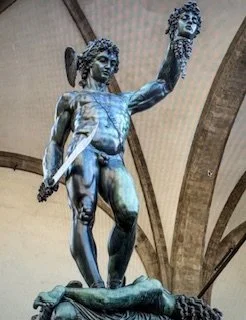
Benvenuto Cellini’s bronze sculpture *Perseus with the Head of Medusa* (1545–1554),