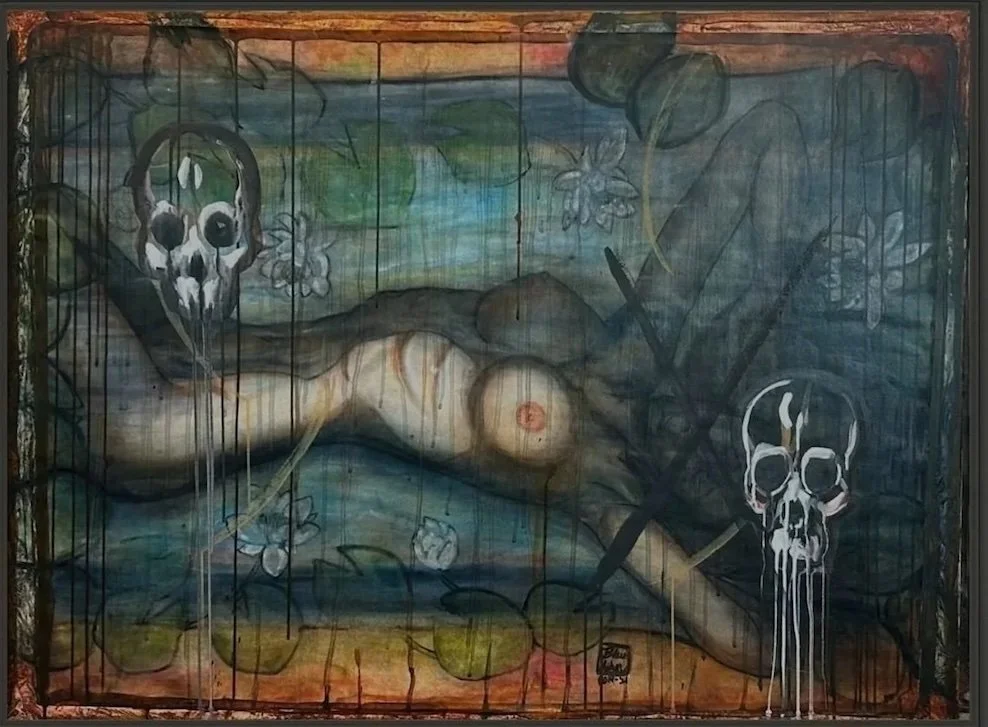
Ophelia [ 40” x 60” ] · Carbon pencil, blackening watercolours, and inks on paper mounted to canvas [ 2018–2025 ]
The mask of submissive sorrow and the quiet surrender to the current.
This painting reinterprets Ophelia’s drowning from Hamlet as a slow, deliberate surrender to grief and madness. She floats face-up already beneath the surface of the stream, eyes open to the sky, hands drifting palm-up among the flowering water lilies— a symbol of rebirth. The blackening water rises around her like ink spreading through paper, her body in slow motion, hair fanning out in dark tendrils.
The blackening drips bleed from the flowers and skulls into the stream, symbolizing how memory, love, betrayal, and loss saturate and overwhelm. Ophelia’s expression is hidden by the masked skull yet distant—resigned, released, perhaps even serene in the moment when mad release becomes freedom. The surface reflects fragments of the world above, while the depths pull her gently downward, a quiet refusal of the court’s poison.
The work confronts the complexity of sorrow: how innocence can be drowned by others’ actions, how masked madness can be both destruction and liberation, how the weight of unspoken pain can carry one away. Yet in the deepest blackening, a faint light catches on the white flowers—the possibility that even in drowning, something pure and honest persists.
A meditation on grief, madness, the fragility of innocence, and the quiet optimism that endures when surrender becomes its own kind of strength—dark yet eternally hopeful in its acceptance of the current.
Dark yet hopeful,
Studio view, or related works: blairaiken@raincage.com
Inspiration & Personal Connection
This painting draws inspiration from John Everett Millais’ iconic *Ophelia* (1851–52), which hangs in Tate Britain in London. I first saw the work during a visit to the Tate and was struck by its haunting beauty — the floating figure surrounded by flowers, suspended between life and death, innocence and tragedy. In Shakespeare's Hamlet, Ophelia’s psychological mask is that of submissive, demure, and silent obedience. This mask is a protective, albeit limiting, persona she wears to navigate a heavily patriarchal and toxic court environment, where she is treated as a pawn by her father, brother, and lover.
Millais painted his Ophelia using Elizabeth Siddal as the model, a relationship that was famously complicated and emotionally charged within the Pre-Raphaelite circle. In my own version, I worked with a model with whom I shared a similarly complex and layered relationship. That personal entanglement deepened the painting — the quiet surrender, the beautiful dissolution, and the delicate tension between grace and loss felt intensely real.
Through the blackening layers, I trace the slow drift into sorrow, the weight of unspoken grief, and the strange beauty that can exist even in endings. Yet even in this moment of drowning, a faint gleam persists — a quiet reminder that every ending carries within it the seeds of transformation and the stubborn possibility of hope that she will surface.
Dark yet hopeful.
Studio view, or related works: blairaiken@raincage.com
Dark yet hopeful.
← Previous Back to Portfolio Works Next →
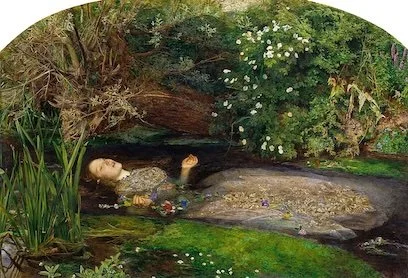
John Everett Millais’ iconic *Ophelia* (1851–52),